Travelers often describe the Lunar New Year (Tet) in Vietnam as a sensory explosion of colors and sounds, but the true essence of this holiday is quietly celebrated around the dining table. For the Vietnamese, the first meal of the year is not merely for sustenance; it is a spiritual dialogue with the cosmos.
Navigating this culinary map can be complex for international visitors. As your local companion, Vietpower Travel invites you to look beyond the flavors. By understanding Vietnam lucky foods, you do not just taste the dish; you partake in a centuries-old ritual of hope, gratitude, and aspiration.
Before we explore the specific dishes, it is crucial to answer the fundamental question: "Why are food symbols so important in Vietnam?" The concept of lucky foods is deeply rooted in the philosophy of "eating for destiny."
Vietnamese cuisine is governed by the balance of Yin (cooling) and Yang (heating) elements. A Tet meal is a calculated orchestra of ingredients designed to bring harmony to the body and soul.
%20lucky%20food.jpg)
Luck is also found in geometry and wordplay.
Let’s continue exploring more about Vietnam and its rich cultural heritage. Visit our Vietnam culture category to discover in-depth guides, traditions, and stories that define this beautiful country.
Here is the essential guide to the 8 symbolic dishes you must try during the Tet Holiday to attract good fortune.
If there is one dish that defines the Tet Holiday, it is Banh Chung (Square Sticky Rice Cake). To the untrained eye, it is a simple block of rice, but to the locals, it is a masterpiece of gratitude.
%20lucky%20food.jpg)
Legend: The Prince And The Rice Cake The origin of this cake dates back to the dawn of Vietnamese history with the legend of Prince Lang Lieu. While other princes competed for the throne with exotic treasures, Lang Lieu used simple agrarian ingredients - rice, mung beans, and pork to create a cake that represented the Earth.
%20lucky%20food.jpg)
FAQ: Why Is Banh Chung Boiled For 12 Hours? Short Answer: The 10-12 hour boiling process ensures the sticky rice acts as a strong glue, binding all ingredients together to symbolize tight family bonds and unity. Context: This long cooking time over a wood fire is the prime time for family gatherings. It is when grandparents tell stories to grandchildren, bridging the gap between generations.
While white rice is a daily staple, the New Year demands something more vibrant. Xoi Gac (Red Sticky Rice) appears on every altar as a beacon of hope.
%20lucky%20food.jpg)
Color Psychology: Why Red? This dish derives its intense orange-red hue from the Gac fruit (Momordica cochinchinensis). In Asian beliefs, red is the color of Yang energy - it symbolizes fire, blood, and life force.
You can find more posts related to this topic in the category below:
If you travel to Southern Vietnam, the scent of coconut water and caramelized pork will welcome you into every home. Thit Kho Hot Vit (Braised Pork with Duck Eggs) is the ultimate comfort food of the South.
%20lucky%20food.jpg)
The Philosophy Of "Vuong Tron" This dish is a poetic representation of the Vietnamese idiom "Me Tron Con Vuong" (Round mother, Square child), implying a safe birth and a complete life.
Often served alongside the rich Braised Pork is the Bitter Melon Soup (Canh Kho Qua). This is a unique example of how Vietnamese people eat based on wordplay.
%20lucky%20food.jpg)
The Linguistic Luck The name of the vegetable, "Kho Qua", literally translates to "Hardships Pass."
For those seeking an answer to "What foods represent wealth?", the crispy Spring Roll (Nem Ran in the North, Cha Gio in the South) is the delicious solution.
%20lucky%20food.jpg)
Visualizing Prosperity Fried to a perfect golden brown, these cylindrical rolls bear a striking resemblance to gold bars.
If you’re inspired to see Vietnam your own way, Vietpower Travel is here to create a journey that fits you perfectly.
In Northern Vietnam, a feast is not a feast without a boiled chicken. However, during Tet, this dish takes on a sacred role, specifically the "Giao Thua" (New Year's Eve) offering.
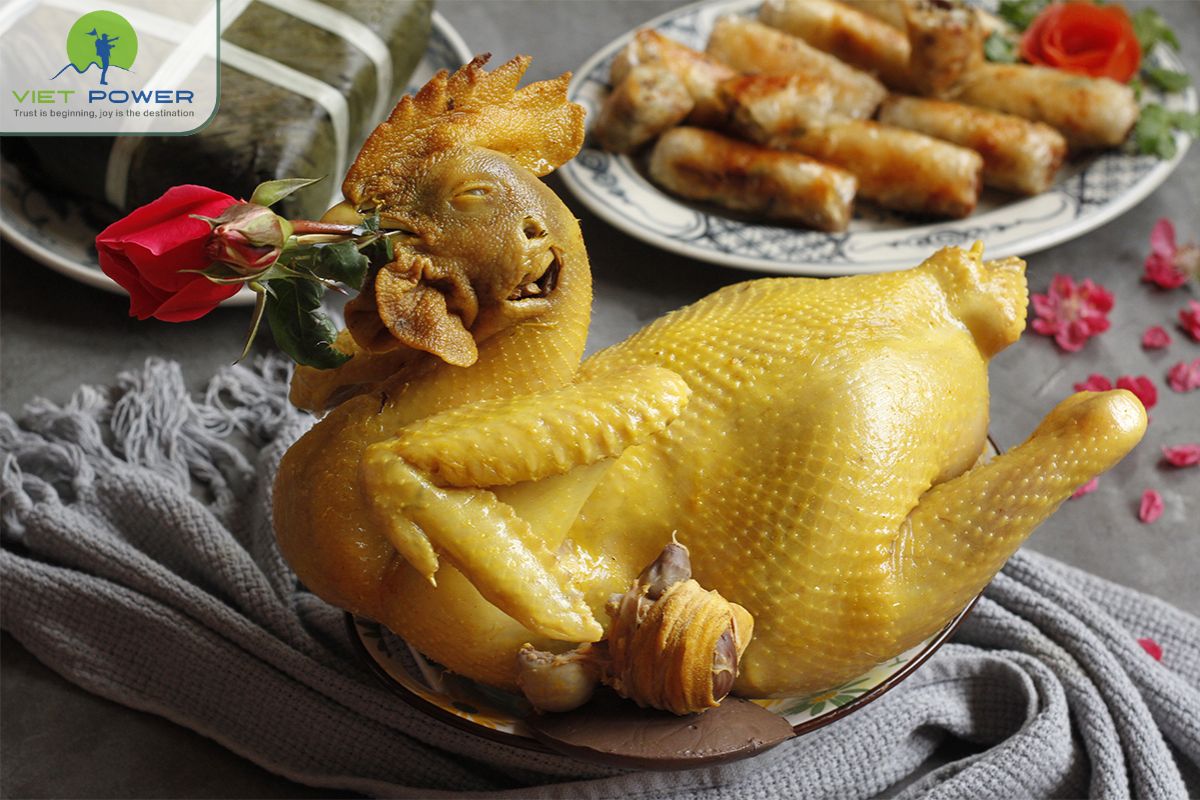
The "Flying Fairy" Pose The rooster chosen for the offering must be perfect. It is boiled with care to keep the skin an impeccable yellow and is often bent into a specific pose - wings spread out and head held high, sometimes holding a red rose in its beak.
The Tray of Five Fruits (Mam Ngu Qua) is the centerpiece of the altar. This is where the cultural diversity of Vietnam shines brightest.
Northern Tradition: The Five Elements The North follows the visual philosophy of the Five Elements (Metal, Wood, Water, Fire, Earth). The tray must have five distinct colors to ensure cosmic balance.
%20lucky%20food.jpg)
Southern Tradition: The Linguistic Art The South rejects bananas because the word "Chuoi" sounds like "sliding" or "failing." Instead, they use a phonetic code:
%20lucky%20food.jpg)
Continue exploring similar posts to learn more about Vietnam’s traditions, heritage, and way of life:
Red on the inside, green on the outside - the watermelon is the fruit of anticipation. Buying a watermelon before Tet is a popular game of chance.
%20lucky%20food.jpg)
The Red Prediction Vietnamese people believe the color of the watermelon flesh predicts the family's fortune.
Vietnamese Tet cuisine is a masterclass in mindfulness. Every bite of Banh Chung or Spring Rolls is a conscious act of hoping, dreaming, and connecting with the past. These lucky foods tell the story of a resilient nation that always looks toward the future with optimism.
To truly understand Vietnam, you must taste its stories. Are you ready to sit at our table and share in these blessings? Plan your cultural tour today with Vietpower Travel. Let us make your next holiday a journey of prosperity.
Please kindly send us your ideas about the tours: destinations, attractions, your group, hotel class... we will get back to you with details & best offers quickly. Surely, you will feel satisfactory!
 |
 |
 |
 |
 |
 |

.jpg) Customize Your Trip
Customize Your Trip
 Vietnam Tours
 Thailand Tours
 Laos Tours
 Indonesia Tours
 Cambodia Tours
 Myanmar Tours